Surface Repair
Elephant Armor DOT Concrete Repair Mortar
High ductility cementitious repair mortar designed to flex without failure. Engineered for government-spec DOT infrastructure, it resists de-icing salts and freeze-thaw cycling at the toughest project sites.
Compressive Strength (4 hrs):4,000 psi [ASTM C109]
Call Chuck: 406-598-4684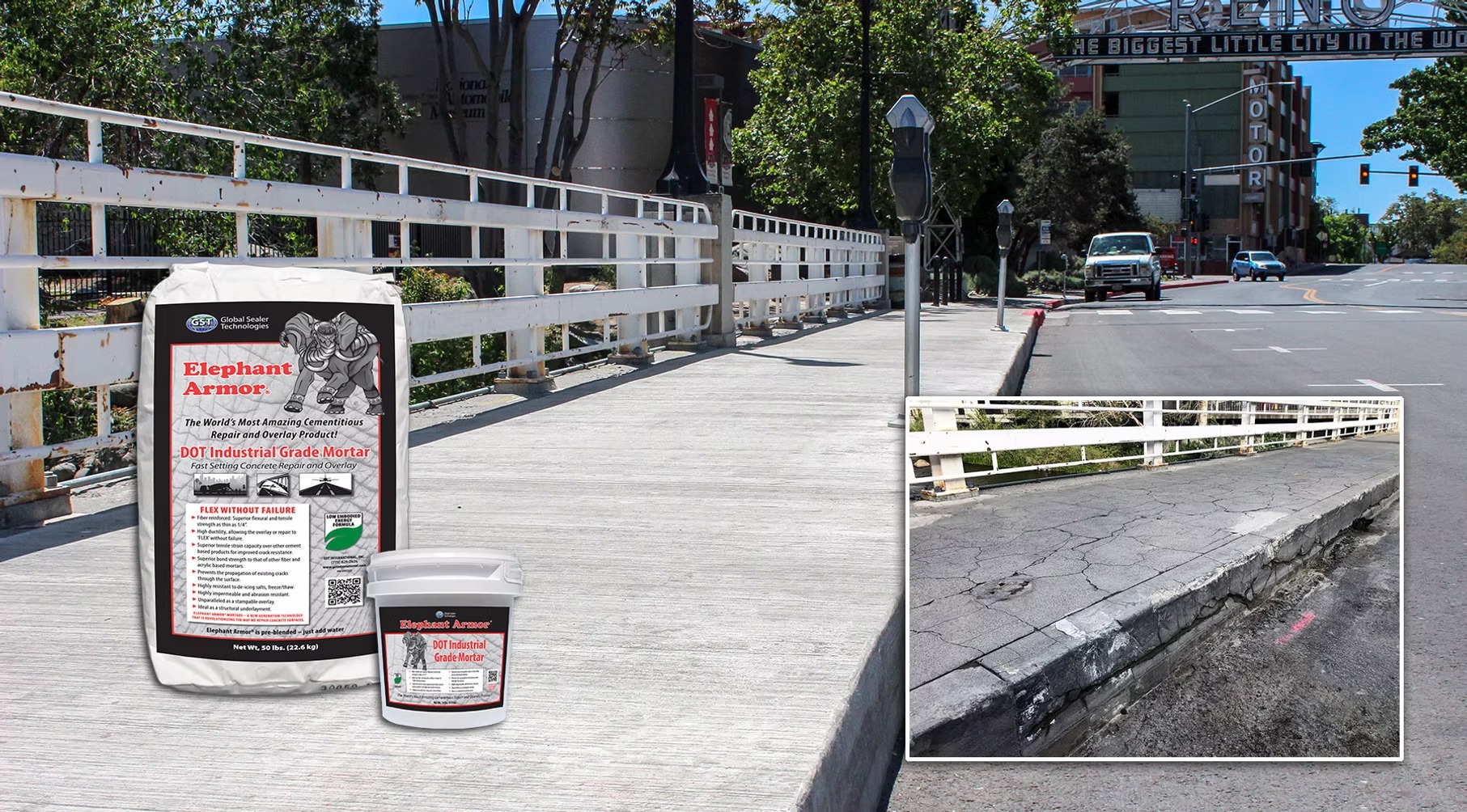 1 / 24
High ductility cementitious repair mortar designed to flex without failure. Engineered for government-spec DOT infrastructure, it resists de-icing salts and freeze-thaw cycling at the toughest project sites.
- Compressive Strength (4 hrs)
- 4,000 psi [ASTM C109]
- Compressive Strength (24 hrs)
- 5,500 psi [ASTM C109]
- Compressive Strength (28 days)
- 7,000 psi [ASTM C109]
- Split Tensile Strength (28 days)
- 600 psi [ASTM C496]
- Flexural Performance (28 days)
- 1,600 psi [ASTM C1609]
- Modulus of Elasticity (28 days)
- 2,700 psi [ASTM C469]
Applications
- Bridges
- Parking structures
- Tunnels
- Dams
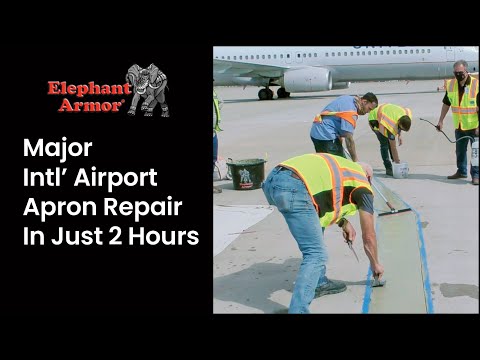
- Runways
Technical Specifications
| Product Specifications | |
|---|---|
| Compressive Strength (4 hrs) | 4,000 psi [ASTM C109] |
| Compressive Strength (24 hrs) | 5,500 psi [ASTM C109] |
| Compressive Strength (28 days) | 7,000 psi [ASTM C109] |
| Split Tensile Strength (28 days) | 600 psi [ASTM C496] |
| Flexural Performance (28 days) | 1,600 psi [ASTM C1609] |
| Modulus of Elasticity (28 days) | 2,700 psi [ASTM C469] |
| Bond Strength (28 days avg) | 2,500 psi [ASTM C882] |
| Chloride Ion Penetrability | 321.52 Coulombs (Very Low) [ASTM C1202] |
| Water-Soluble Chloride | 0.01391% by mass [ASTM C1218] |
| Acid-Soluble Chloride | 0.03087% by mass [ASTM C1152] |
| Thermal Expansion | 4.968 x 10^-6 in/in/°F [AASHTO T-336] |
| Set Time (Initial / Final) | Approx. 50 min / 70 min [ASTM C191] |
| Shrinkage (28 days in water) | -0.019% [ASTM C928 / C157] |
| Packaging | 50 lbs bags or 10 lb pails |
| Yield | 0.5 cubic feet per 50 lb bag (22 sq ft at 1/4" thickness) |
FAQ
- What is unique about GST International’s Elephant Armor® compared to traditional mortars?
- Elephant Armor is a single-component, fiber-based, zero-polymer, engineered ductal mortar—Just Add Water. In addition to a mechanical bond, its Polyvinyl Alcohol (PVA) fibers create a fully engaged molecular bond within the mortar matrix, providing extremely high tensile and flexural strength. It is highly ductile (“Flex Without Failure”), resists de-icing salts and freeze/thaw, and inhibits crack propagation.
- What is the PSI rating and curing speed of Elephant Armor?
- Elephant Armor achieves over 4,000 psi in just 4 hours, allowing rapid return to service. Its ultimate 28-day strength reaches approximately 7,000 psi.
- What is the exact water mixing ratio and mixing procedure per 50 lb bag?
- Consistency is critical: use exactly 5.5 to 6.5 quarts of clean water per 50 lb bag—no more. Pour all water in at once; it does not need to be slowly mixed in. Two bags (100 lbs) can be mixed in a GST EA 70 Quart Mixing Bucket in less than 90 seconds. Excessive water or over-working will cause fibers to be exposed on the surface.
- Why is a ColloMix Xo55 Duo mixer strictly mandated over standard Hippo mixers or drills?
- Due to Elephant Armor’s high fiber content, high shear is required to achieve a homogeneous mix. The ColloMix Xo55 Duo is strictly mandated. Standard Hippo mixers, cement mixers, or 1/2-inch drills cannot provide the necessary shear and must NOT be used.
- Does Elephant Armor need to be “fluffed up” prior to mixing?
- Yes. Due to transportation and storage, the material may become compacted. Roll the bag prior to emptying it into the GST 70 Quart Mixing Bucket. Before adding water, dry mix (“fluff”) the material using the ColloMix Xo55 Duo to ensure proper water integration.
- What special tools and techniques are required to spread and finish Elephant Armor?
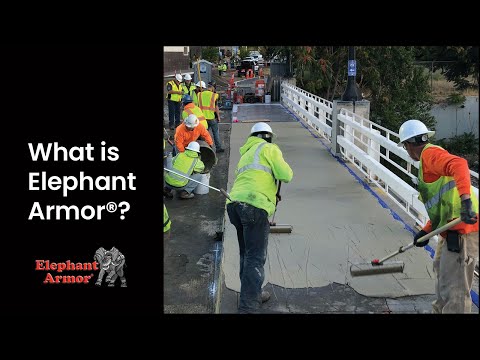
- You must use a GST Texture Roller (looped roller) to spread the material; a metal trowel will pull and grab the material away from the substrate, whereas the roller forces it into the pores to ensure a proper bond. Use a GST Squeegee Trowel for initial finishing. Standard cementing tools can be used once the mortar achieves initial set.
- What is the recommended thickness for overlays, and can it be stamped or broomed?
- Elephant Armor is highly structural at 1/4-inch to 1/2-inch thickness. It accepts all standard textures including stamped, broomed, or smooth squeegee finishes. For overlays thicker than 1/2 inch, consult your local representative.
- What is the recommended practice for deep fills greater than 2 inches or deep small spalls?
- For small spalls exceeding 2 inches in depth, you can fill in a single pass as long as the diameter does not exceed 12 inches. For larger deep fills, use the “Fill and Cap” method in at least two layers, with the final cap not exceeding 1/2 inch thick. Because Elephant Armor creates exothermic heat in volume, timing is critical: if the initial fill hasn’t generated heat or set, place the cap immediately. If heat has begun, wait until the initial fill has fully set and cooled completely before capping so you do not “cook” the top layer.
- Can Elephant Armor be used for vertical/overhead repairs, reverse-casting, or paver overlays?
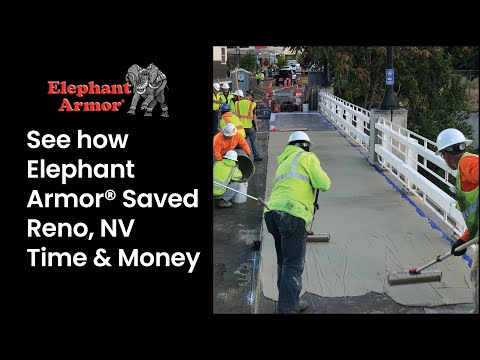
- Yes. It is used extensively on bridges, tunnels, and seawalls for vertical/overhead repairs. It can be reverse-cast for countertops and outdoor kitchens. It can also be placed over unsealed segmental paver systems by pouring a flowable “wet fill” mix into the chamfers to lock pavers down, followed immediately by a 1/4-inch overlay.
- What crew size is recommended for multi-bag or pallet-scale projects?
- For larger pours, use a crew of at least 5 people with dedicated tasks: at least 1 person dedicated strictly to mixing, at least 2 people focused on placing and finishing, 1 floater responsible for cleaning tools and supporting the crew, and 1 dedicated project supervisor.